Market, Exposure & Application Guide
Understanding the PSC / HSF Product Architecture
Products within the hands-free industrial safety portfolio may carry different prefixes or trademarks. This page explains those identities simply and clearly, so the reader understands how each relates to the programme as a whole.
PSC Hand Safety India Pvt. Ltd. is the engineering, manufacturing and product-development organisation behind the hands-free safety programme.
Products engineered and manufactured within the PSC portfolio carry the PSC prefix. This identifies the engineering and manufacturing source of the solution.
Hand Safety First® (HSF) is PSC's specialist hand-safety platform — the brand and framework through which engineered solutions for reducing hand exposure are developed, organised and presented to industry.
The HSF philosophy is: Engineer the Hand Out of the Hazard™
The HSF prefix identifies solutions where the hand-safety application and methodology leads the product identity, rather than the manufacturing process.
Some solutions carry their own established product trademark. Where a product has a strong standalone identity — such as RiggerSafe® — that trademark leads. The PSC or HSF prefix is not artificially added to an individual product name where it is not part of that product's established identity.
These individual trademarks are part of the same integrated hands-free industrial safety portfolio. The prefix does not define which organisation stands behind the product — all products in this guide are part of the PSC Hand Safety India / HSF programme.
Different product identities. One engineering objective:
Reduce the need for the worker's hand to enter the hazard zone.
The Australian Industrial Context
Australia as a Resources Economy
The practical consequence of this scale is not simply large mines. It is an enormous number of maintenance, lifting, rigging, positioning, alignment, shutdown and material-handling tasks occurring continuously across those operations.
The Maintenance Dimension
Each major mining operation is itself a concentration of recurring manual tasks. A single mine site may involve:
- Heavy mobile equipment workshops
- Fixed-plant shutdown maintenance
- Conveyor and crushing systems
- Crane and rigging operations
- Structural assembly and installation
- Pipe, tubular and hose handling
- Stores, logistics and truck loading
- Contractor maintenance activities
Each of these environments may contain multiple hand-exposure points. A mine is not a single application — it is a network of recurring tasks, each of which may benefit from an engineered interface between worker and object.
The scale of Australian mining is well understood. The opportunity for hands-free industrial safety tools lies not in that scale alone, but in the density of hand-exposure tasks that occur within it — in workshops, on rigging platforms, during shutdowns, at conveyor systems, on truck loading decks and at crane landing zones across every operation.
Engineering Controls Before PPE
Australia's model Work Health and Safety (WHS) laws — implemented in all states and territories except Victoria, which maintains comparable obligations under its own OHS Act 2004 — place the hierarchy of controls at the centre of risk management. 1 Across all Australian mining jurisdictions, the framework requires employers to eliminate or minimise workplace risks so far as is reasonably practicable. Engineering controls rank above administrative controls and PPE in this hierarchy. The obligation is not simply to provide gloves — it is to consider whether an engineering control can reduce or eliminate the exposure first.
In practice, PPE and engineering controls serve different purposes:
A glove reduces the consequence of contact. An engineered control reduces the need for contact to occur in the first place.
The goal of hands-free industrial tools is not to claim that every task can become entirely hands-free. The goal is to identify tasks where the worker's hand is functioning unnecessarily as a guide, stabiliser, alignment device, retrieval mechanism, lifting point or positioning tool — and to provide an engineered alternative that achieves the same outcome without requiring the hand to be in the exposure zone.
Engineered hand-separation tools operate at Level 3 (Engineering Controls) in the WHS hierarchy. 1 Safe Work Australia, Model WHS laws: safeworkaustralia.gov.au/law-and-regulation/model-whs-laws
The Hand Becomes the Control
Many industrial tasks continue to depend on direct hand contact not because hand contact is desirable, but because no engineered alternative has been provided. When a worker must guide a suspended load, hold a chisel, align a structural member, retrieve a tagline or position a heavy component — and no tool exists to do this at a safe distance — the hand becomes the default control mechanism.
2 NSW Resources Regulator, Mine Safety Performance Report 2024–25 (resources.nsw.gov.au, February 2026) · 3 NSW Resources Regulator, Safety Bulletin SB22-04, March 2022
Australia Regional Market Map
The following maps principal mining and heavy-industrial regions against the types of hand-exposure environments likely to occur. Each region is relevant not merely for its commodity value, but for the concentration of maintenance, handling, rigging and workshop activity within its operations.
- BHP, Rio Tinto, Fortescue — Pilbara iron ore
- Newmont, Northern Star — gold (Kalgoorlie, Super Pit)
- Pilbara Minerals, Albemarle — lithium (Pilgangoora)
- South32, IGO — base metals/nickel
- Woodside Pluto LNG, Chevron Gorgon/Wheatstone — Karratha
- Mobile equipment workshops (haul trucks, loaders)
- Crushing, screening and conveyor maintenance
- Crane and rigging at ore-loading facilities
- Heavy component lifting and installation
- LNG valve, flange and pump maintenance
- Port operations — ship loading, crane maintenance
- Shutdown and turnaround activities
- Glencore, BHP, Anglo American, Whitehaven — Bowen Basin coal
- Peabody Energy, New Hope — coal operations
- Gladstone port and bulk handling
- Queensland Alumina / refineries — Gladstone
- Gold and base metal operations — Mt Isa region
- Longwall mining maintenance — heavy equipment
- Dragline maintenance — structural and mechanical
- Conveyor system maintenance — large-scale
- Mobile equipment workshop activity
- Bulk terminal crane and rigging operations
- Maintenance contractor environments
Australia Regional Market Map — NSW, SA & NT
Additional major resource and heavy-industrial regions, shown separately to preserve A4 readability.
- Hunter Valley open-cut and underground coal
- Newcastle — largest coal export terminal globally
- Mining maintenance, structural handling, fixed-plant
- Heavy industrial fabrication and infrastructure
- BHP Olympic Dam — copper/uranium, SA
- Oz Minerals (acquired by BHP) — base metals
- Santos/INPEX Darwin LNG — heavy maintenance
- Remote mine-site workshops, infrastructure
Where Hands-Free Tools Apply in Australian Mining & Heavy Industry
For each operational environment, the mapping follows a consistent sequence: what the task is, what the hand currently does, what the exposure mechanism is, and where an engineered tool can provide separation. Products are the solution at the end of the chain — not the starting point.
Mine Maintenance Workshops
Mine maintenance workshops concentrate a large number of hand-exposure tasks in a single environment. The combination of heavy components, repetitive mechanical work, confined access, impact operations and awkward manual handling creates conditions where the hand is routinely placed in proximity to hazards.
- Removing bearings, pins, couplings, seals
- Reinstalling heavy fabricated components
- Hand used for alignment during assembly
- Fingers used to guide parts into position
- Hand caught between component and housing
- Unexpected component movement under load
- Crush during final seating of heavy part
- Misalignment causing sudden shift
- Lift Assist for heavy awkward components
- Push/Pull tools for final alignment
- Magnetic handlers for ferrous parts
- Alignment guides to replace finger-guiding
- Driving pins, drifts, cold chisels
- Removing seized bolts and components
- Splitting, punching, staking
- Finger holds chisel/punch during striking
- Hammer misses — strikes holding hand
- Chisel or punch recoils on to hand
- Scale or metal fragments projected
- Fatigue causes reduced control
- Chisel & Punch Holder — removes hand from strike line
- FingerSaver® — dedicated finger-protection tool holder
Mine Maintenance Workshops — Handling Exposures
- Pipe and hose assemblies are heavy, unwieldy
- Hand pinched between pipe and rack/structure
- Handle-Tech Pipe Lifter for positioning
- Tubular Guider for alignment during installation
- Welding, cutting, oxy-fuel cylinders in use
- Hand caught during positioning or racking
- Cylinder rolls unexpectedly — pinch risk
- Gas Grab provides controlled handling grip
Truck Loading & Unloading of Heavy Structures
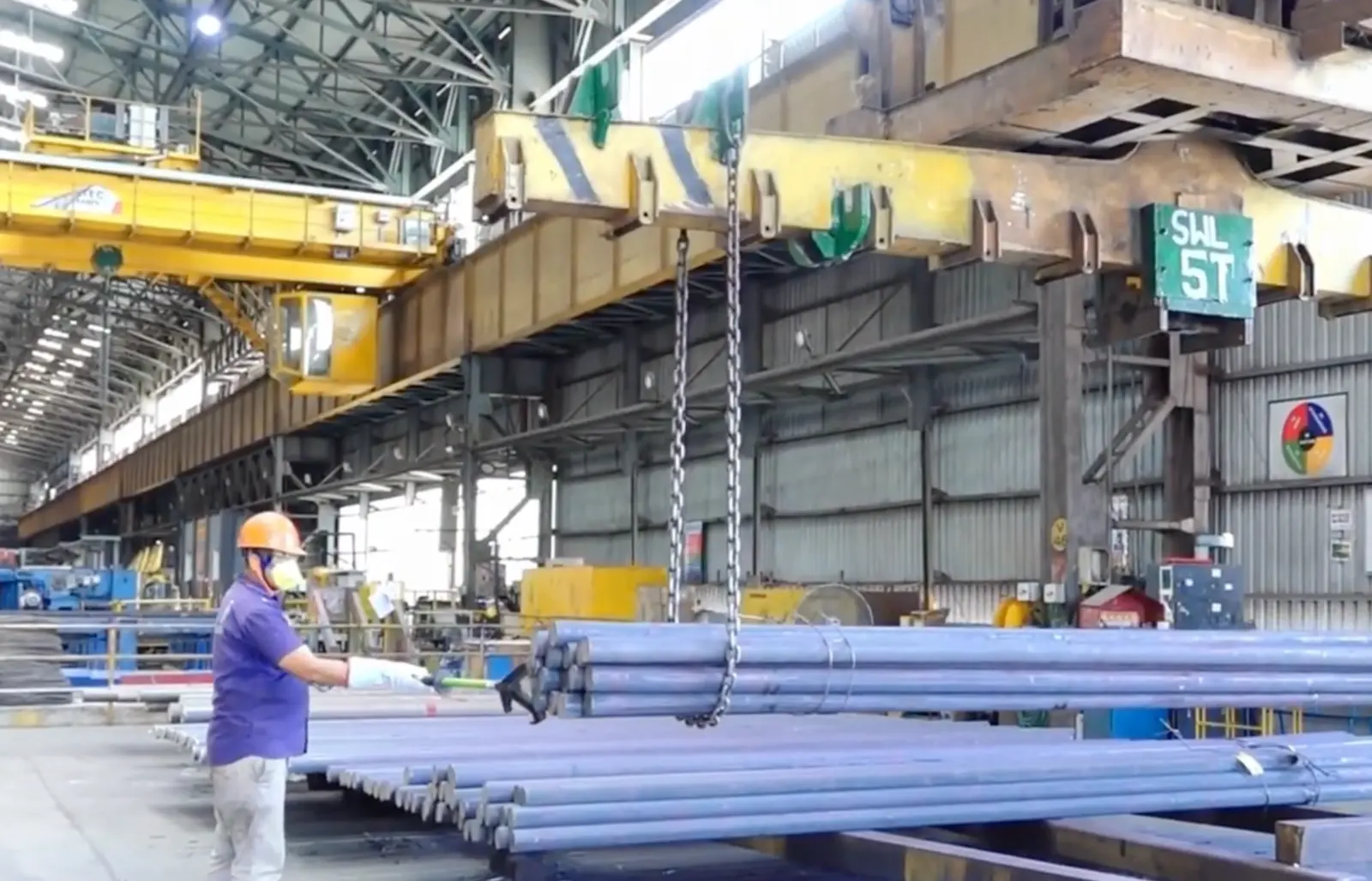
The loading and unloading of heavy, awkward or fabricated structures onto and off flatbed trailers is one of the most consistently identified high-exposure tasks in Australian mining and industrial operations. Workers routinely guide loads by hand during crane lifts, place hands between loads and trailer decks during landing, and handle taglines in close proximity to moving loads.
- RiggerSafe® push/pull standoff tools — guide load without hand contact during swing and landing
- Anti-Tangle Taglines — controlled load management at a safe distance from the load
- Tagline Retriever — remote tagline management without entry into landing zone
- LoadGrab® — remote load-positioning control for final placement
- Magnetic Load Control — where loads are ferrous and geometry permits
- Tubular Guider — where pipe or tubular sections are the load being positioned
- Hand between load and trailer deck during landing
- Load swing or rotation causing contact
- Worker in pinch zone during final positioning
- Tagline wrapping around hands or wrists
- Worker proximity to crane hook zone
- Sling engagement and removal at height or reach
Note: Tool selection should follow application assessment. Not every tool suits every truck-loading scenario — load geometry, crane type, work method and available space all affect tool selection.
Suspended Load Guidance
Suspended loads present multiple exposure mechanisms. A load on a crane hook continues to move under its own momentum after the crane has stopped. Wind, rope angle, load geometry and surface irregularity all contribute to drift, swing and rotation. The instinctive response — reaching out to stop or redirect the load — places the hand directly in the line of fire.
Different stand-off tools serve different control requirements and must be selected by application:
- RiggerSafe® Push/Pull tools — rigid stand-off for coarse load management; operator directs load without hand contact
- Taglines (Anti-Tangle) — flexible control over longer distances; managed wrap prevents tangling and sudden force transfer to hands
- Tagline Retriever — remote tagline recovery without worker entering the landing zone
- LoadGrab® — remote load control for fine positioning
These mechanisms are distinct and may require different tools. Push/pull standoff is not interchangeable with tagline control — each addresses different aspects of load management.
Heavy Structure Positioning
The installation of structural steel, fabricated assemblies, equipment frames, machine skids, equipment modules and infrastructure components involves a progression from coarse positioning to fine alignment. Each stage carries different exposure profiles — and the most hazardous stage is often the final few hundred millimetres, when workers instinctively reach toward the load to achieve precise placement.
The final alignment phase can create particularly concentrated hand exposure. The load is nearly in position. Workers can see the target. The instinct is to reach in and guide the last few hundred millimetres by hand — because no engineered alternative has been provided for that final stage of control. This is precisely where an engineered interface can replace the hand.
Relevant tools: RiggerSafe® for standoff control during orientation; LoadGrab® for final remote positioning; Tubular Guider where cylindrical or tubular structures must be aligned; Magnetic Load Control where ferrous components and geometry permit.
"The most dangerous phase of heavy structure installation is often the last few hundred millimetres — when the load is almost in position and workers reach in to complete the alignment by hand."
Pipe & Tubular Handling
Pipe and tubular handling occurs across mining workshops, processing plants, LNG facilities and infrastructure projects. Pipe sections are heavy, often round (and therefore prone to rolling), and must be precisely aligned for connection. The hand is commonly used for:
- Steadying pipe during crane lift
- Guiding pipe during thread engagement
- Positioning stockyard pipe sections
- Stabilising hose assemblies during connection
Engineering controls by task: Handle-Tech Pipe Lifter for workshop lifting and positioning; Tubular Guider for alignment during connection; Push/Pull tools for general standoff guidance; hooks and tongs for stockyard handling where applicable. Selection depends on pipe diameter, weight and access conditions.
Conveyor & Process-Plant Maintenance
Conveyor systems and process plants undergo frequent maintenance shutdowns. Activities include replacement of idlers, chute liners, belt scrapers, crusher liners, wear plates and maintenance of drives and transfers. The combination of heavy components, confined access and stored-energy environments creates multiple exposure points:
- Heavy liner and idler reinstallation
- Component alignment in confined chute spaces
- Pinch-point risk during guard removal/reinstallation
- Crusher component positioning under overhead crane
Relevant tools depend on component weight and geometry. Lift Assist for heavy components without crane access; Push/Pull tools for final positioning; Chisel & Punch Holders where dismantling requires impact work. Application review recommended before selection.
Mobile Equipment Workshops
- Pin extraction and reinstallation — heavy pins in confined spaces
- Hose and pipe assembly installation on large equipment
- Component alignment when reassembling drivetrains
- Truck tray and body handling — large fabricated panels
- Bucket and attachment work — heavy, awkward lifting
Relevant tools: Lift Assist for heavy awkward components; Chisel & Punch Holder for pin-driving operations; Push/Pull tools for alignment; Pipe Lifter for hose and pipe assembly. Most mobile equipment workshops also use impact work (hammer and drift) for pin extraction — Chisel & Punch Holders are directly applicable.
Gas Cylinder Handling
Welding, cutting and gas cylinders are in use across every mining workshop, fabrication facility and maintenance environment. Handling risks arise during:
- Moving cylinders from storage to work area
- Positioning into storage racks
- Final placement against walls or fixed points
- Cylinders rolling during manoeuvring
The Gas Grab provides a controlled grip on standard gas cylinders, reducing the risk of the hand being caught between the cylinder and a fixed structure during positioning. Selection should confirm cylinder compatibility before trial.
Strike & Impact Work
Ports & Bulk Material Handling
Australian ports handle some of the world's highest volumes of iron ore, coal, copper, LNG and mineral exports. Port crane operations, bulk cargo handling, ship-loading systems and marine maintenance all generate hand-exposure tasks similar to those on mining sites:
- Crane rigging — suspended load management
- Bulk grab bucket and sling engagement
- Ship-loader and stacker maintenance
- Heavy conveyor maintenance at berths
- Vessel mooring and marine maintenance
Load control tools (RiggerSafe®, taglines) and workshop hand-safety tools apply across port maintenance and cargo-handling environments. Port maintenance contractors are a relevant account category separate from the mine operators they serve.
Exposure-to-Intervention Matrix
The following matrix maps principal Australian mining and heavy-industry tasks against relevant exposure types and potential engineering interventions. A filled circle indicates a commonly relevant exposure and potential application. A partial circle indicates conditional relevance depending on specific geometry, access or work method. Where application geometry, weight, temperature, access or operating method significantly affects suitability, an application review is required before tool selection is made.
Australian Launch Product Families
The following product families form the initial hands-free industrial safety portfolio for Australian mining and heavy industry. Descriptions follow the same structure: primary exposure addressed, typical Australian applications, what the tool does, what it does not do, and selection considerations.
Hand contact with suspended or moving loads during crane operations, rigging, truck loading/unloading and heavy structure positioning.
- Guiding suspended loads during mine crane operations
- Load management during truck loading/unloading
- Structural steel and fabricated assembly positioning
- Infrastructure component installation
- Port crane and bulk terminal operations
Provides a rigid or semi-rigid stand-off that allows the operator to push, pull, guide and direct a suspended load without hand contact. Available in 21", 42", 50", 72" and 96" lengths to suit different standoff requirements.
RiggerSafe® is not a lifting device. It does not replace rigging equipment, slings or taglines. It is a standoff control tool, not a load-control restraint system.
Length selection depends on required standoff distance and load geometry. Multiple tools may be used per lift for bilateral control.
Australian Launch Product Families — Load Positioning & Taglines
Hand contact during final load positioning and landing. Remote load management to keep operator clear of pinch zone.
- Fine positioning of suspended loads
- Crane landing operations at mines and ports
- Truck loading final placement
Application assessment required for load geometry and weight. Not interchangeable with RiggerSafe® — serves a different control function.
Tagline wrapping, sudden force transfer and worker proximity to landing zone during crane operations.
- Crane lifts in mining and port environments
- Suspended load control at distance
- Remote tagline recovery after landing
Anti-tangle design reduces injury from sudden tagline tension. Retriever eliminates need to enter landing zone to collect tagline.
Hand and finger in the strike zone when using chisels, punches, drifts and cold chisels with a hammer.
- Mining equipment pin extraction and driving
- Cold chisel work on seized components
- Drift pin operations in fabrication
- General impact driving in maintenance workshops
Does not replace appropriate impact tool selection. Does not suit all chisel or punch dimensions — confirm tool compatibility before ordering.
Finger in the line of hammer strike when holding pins, nails, small chisels or similar items for driving.
Workshop operations involving any manual nail, pin or small chisel driving. Selection depends on size of the item being held and work geometry.
Hand between heavy awkward component and adjacent structure or floor during manual lifting and positioning where crane access is impractical.
- Workshop component lifting and repositioning
- Awkward assembly installation in confined spaces
- Heavy part movement between workstations
- Mine maintenance environments with restricted access
Weight and geometry of component determine suitability. Application review recommended for non-standard components.
Hand pinched during pipe rolling, alignment or positioning; hand between pipe and fixed structure or floor.
- Workshop pipe positioning and connection alignment
- LNG, process plant and mining pipe handling
- Tubular guiding during crane installation
Hands in contact with ferrous structural members, plates and components during crane operations. Magnetic load control provides hands-free engagement with compatible ferrous loads. Selection requires confirmation of load weight, surface condition, material grade and lift geometry. Not applicable to non-ferrous loads.
Hand caught between cylinder body and fixed structure during manoeuvring and positioning of welding, cutting and gas bottles. Gas Grab provides a secure external grip that reduces pinch exposure during movement. Confirm cylinder size compatibility before ordering.
Building a Hands-Free Safety Demonstration Programme
A hands-free safety demonstration programme allows an operation, EHS team or safety advisor to evaluate engineered hand-separation controls across different exposure categories. The purpose is not to present a product catalogue — it is to demonstrate that a range of engineered interfaces exist for different types of hand exposure, and to identify which are most relevant to the specific tasks and environments at a given operation. Application review determines tool selection.
- RiggerSafe® — push/pull standoff for suspended load guidance without hand contact
- Anti-Tangle Taglines — controlled load management at a safe working distance
- Tagline Retriever — remote tagline recovery without entering the landing zone
- LoadGrab® — remote load positioning during final placement
- Suspended load guidance during crane operations
- Crane landing zones — truck loading and unloading
- Structural positioning and heavy assembly installation
- Port crane and bulk terminal rigging operations
- Lift Assist — for heavy or awkward components where crane access is impractical; suitability depends on component weight and geometry
- Handle-Tech Pipe Lifter — pipe and tubular handling in workshop and process-plant environments
- Heavy awkward component lifting — workshop environments
- Pipe movement, alignment and positioning
- Confined-space maintenance handling tasks
Demonstration Programme — Additional Exposure Families
- Chisel & Punch Holder — removes hand from the strike line during hammer and chisel operations; confirm tool size compatibility
- FingerSaver® — for pin-driving and small chisel work where the finger holds the driven item
- Pin extraction and driving in mine maintenance workshops
- Cold chisel and drift operations on seized components
- General impact work in fabrication and mechanical maintenance
- Tubular Guider — pipe and tubular alignment during crane installation and workshop connection; application review required for geometry and access
- Magnetic Load Control — applicable to ferrous loads only; material grade, weight and surface condition must be confirmed before selection
- Gas Grab — welding, cutting and gas cylinder positioning; confirm cylinder diameter compatibility before ordering
Application review determines tool selection. Where load geometry, access, material or operating method is non-standard, the appropriate tool family should be confirmed through an application review before a trial is conducted.
Where These Exposures Occur Across Australian Industry
The hand-exposure environments described in this guide occur across a wide range of Australian mining, resource and industrial operations. The following maps the principal operational categories and illustrates the scale and diversity of environments where hands-free safety tools may be relevant. Named organisations are examples of major Australian operating environments — they are not HSF/PSC customers, they have not endorsed this methodology, and no site-specific assessment of their operations has been made.
Examples of major Australian operating environments include:
- BHP — Pilbara iron ore (WA), Olympic Dam copper/uranium (SA), Queensland coal
- Rio Tinto — Pilbara iron ore, Weipa bauxite, Queensland coal
- Fortescue — Pilbara iron ore, Western Australia
- South32 — Worsley Alumina (WA), Cannington (QLD), Illawarra Metallurgical Coal
- Glencore — Bowen Basin coal, Mt Isa operations, Queensland
- Whitehaven Coal — NSW and Queensland coal operations
Examples of major operating environments:
- Newmont — Boddington (WA), Tanami (NT), Cadia (NSW)
- Northern Star Resources — Kalgoorlie/Super Pit (WA)
- Evolution Mining — Mt Rawdon (QLD), Ernest Henry (QLD)
- Woodside Energy — Karratha LNG (WA)
- Santos / INPEX — Darwin LNG (NT)
- Chevron Australia — Gorgon and Wheatstone LNG (WA)
Operations at this scale concentrate maintenance, rigging, workshop, shutdown and material-handling activity across multiple facilities. Many distinct hand-exposure environments exist within each operation.
Where These Exposures Occur — Services, Workshops & Ports
Mining services and maintenance contractors concentrate the highest-density hand-exposure environments. Shutdown, mechanical maintenance, rigging and heavy engineering activities on mine sites involve many of the task types described in this guide. These contractor environments often standardise engineering controls across multiple client sites.
- Mine shutdown and maintenance contractors
- Heavy engineering contractors on mine sites
- Plant and equipment maintenance specialists
- Rigging and lifting contractors
- Mobile-plant and workshop service providers
Mining OEM service centres, equipment rebuilders and component remanufacturers concentrate repetitive workshop exposure. These environments perform high-frequency chisel, punch, pin-driving, heavy-component lifting and pipe-handling operations — multiple hand-exposure task types in a single facility.
Australia's bulk export ports handle iron ore, coal, copper and mineral exports at significant scale. Examples include Port Hedland (iron ore), Newcastle Coal Infrastructure Group, Dalrymple Bay (QLD coal), Hay Point and Gladstone. All involve crane operations, bulk handling and maintenance activities with hand-exposure profiles similar to mine sites.
One Mine — Many Hand-Exposure Environments
A mine site is not a single application. It is a network of operational environments, each of which may contain multiple tasks where the hand enters the exposure zone unnecessarily — because no engineered alternative has yet been provided for that specific task. The principle that follows from this is not commercial; it is technical.
Do not begin with the catalogue. Begin with the exposure. Identify one task where the hand enters the hazard zone. Evaluate an engineered intervention. Document the result. Then look for similar exposures elsewhere in the operation.
This sequence compounds. Each successful application creates a documented reference within the operation. Each reference reveals the next exposure opportunity. The value is not in the first tool deployed — it is in the systematic reduction of hand exposure across an operation's many different task environments.
Site Application Review Method
The following ten-step method allows an EHS manager, safety advisor or technical sales representative to identify and evaluate hand-exposure tasks systematically. Customer photographs and videos can be reviewed remotely by HSF/PSC engineering to recommend appropriate tool solutions.
Application Case-Study Framework
Australian application references are currently in development. The following framework establishes the standard for documenting each successful trial, ensuring that real field evidence is captured systematically and can be used for future customer reference, EHS presentations and technical publications.
Application photography and video can be sent to HSF/PSC for remote engineering review and tool recommendation. Customer identity can be withheld — the task and exposure are what matter for selection.
Building Australian Technical Authority
Technical authority in Australian mining and heavy industry is built through real application evidence, not generic promotional content. The following activities are the foundation of that authority:
- Australian customer trial photographs and videos
- Documented application case studies in standard format
- Before-and-after task photography from real mine-site trials
- Worker and EHS officer feedback records
- Mining-sector-specific application guides
- Hands-free working best-practice documentation
- Hand-exposure control SOPs for key mining environments
- This market guide — updated as Australian references develop
- EHS webinars targeting Australian mining safety managers
- Toolbox-talk material for site teams
- Site demonstration programmes with documented outcomes
- Technical LinkedIn content — application-specific, evidence-based
- Application-specific pages for major mining exposure environments
- Technical LinkedIn content — application-specific, evidence-led
Australian technical authority should be built from documented applications, not generic promotional claims. Real evidence from real tasks, evaluated at real sites, is what establishes this programme as technically credible in the Australian mining environment.
From Trial to Site Standard
Introducing an engineered hand-separation control follows a consistent process. The steps below apply whether the evaluation is being led by an EHS manager, a safety advisor, an operations team or a technical specialist. The goal at each stage is rigour — a well-documented trial produces evidence that can be applied to other tasks, other departments and other sites.
Observe the actual task as it is performed. Identify where the worker's hand enters the exposure zone, and why. The task photograph or video is the starting point.
Determine what function the hand is providing in this task:
Determine whether an engineered interface can perform that function at greater separation from the hazard. Where the application is non-standard, review with HSF/PSC engineering before proceeding.
Conduct a controlled evaluation under supervised conditions using the selected tool. Document the trial conditions, load type, task geometry and operator experience level.
From Trial to Site Standard — Validate, Document, Standardise, Replicate
Collect structured feedback from:
- Operators — ease of use, adequacy of control, practical concerns
- Supervisors — workflow integration, productivity impact
- EHS team — engineering-control adequacy, limitations
- Document any modifications required or limitations identified
Record the application in the standard format:
- Task · Previous method · Hand exposure
- Engineering intervention selected
- Trial outcome · Operator feedback
- EHS review · Limitations learned
Where the trial is successful, incorporate the method into the appropriate standard:
- SOP · Lifting plan · Workshop practice guide
- Site equipment standard · Toolbox training
Search for similar hand-exposure tasks:
The objective is not tool adoption. The objective is exposure reduction.
Tool adoption is the consequence of a successful engineering intervention.
Conclusion
Industrial hand injuries in mining and heavy industry often occur not because workers lack protective equipment, but because the task still requires the hand to function as part of the control system. The hand guides the suspended load because no stand-off tool is available. The hand holds the chisel because no remote holder has been provided. The hand reaches into the landing zone because no tagline retriever allows the worker to stand clear.
The WHS hierarchy of controls asks employers to address this sequence in order: eliminate the hazard; substitute a safer method; apply an engineering control; then — and only then — rely on administrative controls and PPE. Engineered hand-separation tools sit at Level 3 of that hierarchy. They are not an alternative to PPE. They are a prior and more durable layer of protection.
Australian mining and heavy industry presents an unusually dense concentration of tasks where this engineering-control approach is applicable. The sector's scale creates not one large market but a network of recurring exposures across workshops, crane pads, conveyor lines, truck bays, process plants, shutdown teams and contractor environments at every operation.
The approach that works in this environment is not product-led. It begins with a task. It identifies where the hand enters and why. It asks whether an engineered interface can provide that control at a distance. Where the answer is yes, a tool is selected, trialled, documented and standardised. That successful application then becomes the starting point for the next exposure, the next department, the next site.
The hand should not become the default engineering solution simply because a task requires control.
Where practical, an engineered interface can allow a worker to guide, position, retrieve, align, stabilise or control an object while maintaining separation from the hazard.
The process begins not with a product, but with a question:
Where is the hand — and why does it need to be there?
Find that exposure first. Then determine whether the hand can be engineered out.
Where practical, the safer approach is to provide an engineered interface that allows the worker to guide, position, retrieve, align, stabilise, lift and control — without placing the hand directly into the exposure zone.
For application enquiries, tool selection support or remote task review:
PSC Hand Safety India Pvt. Ltd. 28 Founta Plaza, Suryabagh Visakhapatnam 530020, India
All statistics are cited from their primary Australian government or regulator sources. Where figures are jurisdiction-specific (e.g. NSW mining), this is stated in the text. Market figures are subject to revision as commodity prices change. This publication does not constitute legal, regulatory or engineering advice. Product suitability for specific applications requires an application review and controlled evaluation.
From reading to application
Describe the task, the moving load and the point where hands approach the hazard. Use the PSC catalogue to identify the relevant function, then request selection support.
Browse PSC & HSF tools ↗ · Australian sources and further reading ↗